The Sleep Score Is a Clue, Not a Verdict
You wake up feeling fine, open your health app, and see a low sleep score. Maybe it says you had too little deep sleep, woke up too often, or should be more recovered. Suddenly a decent morning feels like a health problem.
That reaction is common because wearables turn a complicated night into clean numbers and color-coded stages. The numbers look scientific, but a consumer watch is not watching your brain sleep. It is estimating what might have happened from signals it can collect at your wrist.
That does not make sleep trackers useless. Used thoughtfully, a smartwatch may help you notice when your schedule shifts, how consistently you go to bed, or whether a habit seems to coincide with a change in your sleep. The useful question is not “Was my score good?” but “Is there a pattern here worth paying attention to?”
This guide explains what sleep wearables can and cannot measure, how to use one without becoming anxious about the dashboard, how to protect the data it collects, and when symptoms deserve a conversation with a health professional. It is general information, not a diagnosis or treatment plan.
What a Wrist Tracker Actually Measures
Sleep is more than lying still with your eyes closed. In a sleep laboratory, clinicians can use measures such as brain activity, eye movements, muscle activity, breathing, and heart signals to assess sleep and identify specific disorders. A typical wrist wearable does not collect that full set of measurements.
Depending on the device, it may use a combination of:
- Movement: an accelerometer detects motion and stillness. Little movement can be consistent with sleep, but it can also happen while you are quietly awake.
- Pulse-related signals: optical sensors estimate changes in blood volume at the skin to derive heart-rate information. The device may use this alongside other signals in its sleep algorithm.
- Breathing-related estimates: some devices infer or estimate patterns from motion, pulse signals, or other sensors. The exact method and availability vary by model.
- Time and behavior patterns: when the device is worn, when you tend to go to bed, and when you usually wake may influence estimates.
The watch combines those signals with software rules to label periods as asleep, awake, or a particular sleep stage. Those labels are algorithmic estimates. The brand may change its method through software updates, and two brands can interpret the same night differently.
This distinction matters. The device is measuring signals at the wrist; it is not directly observing the full physiology used in a clinical sleep study. A number shown to one decimal place can still be an estimate.
Which Numbers Are More Useful?
Not every metric deserves equal attention. Think of the app as a rough journal, not a medical monitor.
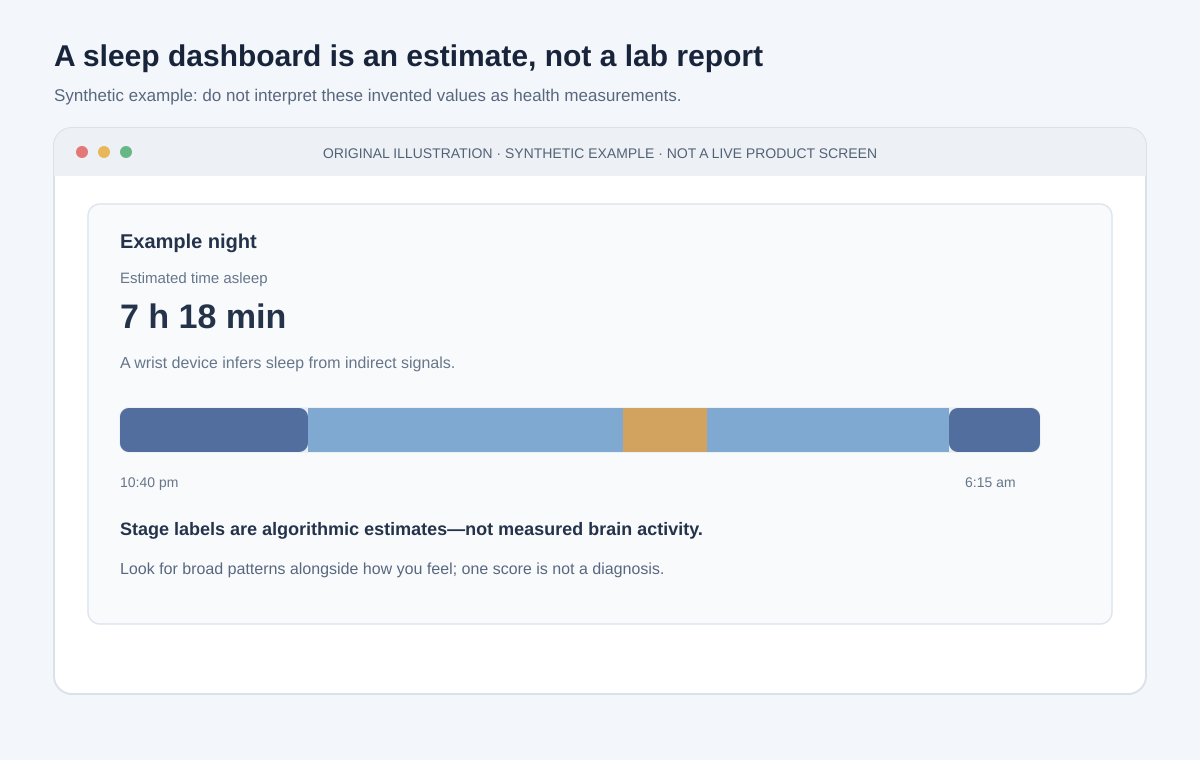
Illustrative dashboard with invented values; consumer wearables estimate these signals and do not provide a sleep-lab report.
Sleep and wake timing
If your device is worn consistently, its estimates may help you spot whether your bedtime and wake time are shifting across the week. Timing can be useful for reflection because it is concrete: you can compare the pattern with your work schedule, travel, caregiving, or routines.
Even here, the watch may mistake quiet wakefulness for sleep, or fail to recognize that you took the device off. Treat the chart as a reminder of what the app inferred, not a minute-by-minute record of what you experienced.
Approximate time asleep
An estimate of total sleep time can provide a rough trend, particularly if you use one device consistently. But it is not a precise audit of every minute. A long period of stillness can be misread as sleep, and a restless night can be misclassified.
If you need to understand a sleep problem, your own report—how long it seems to take you to fall asleep, how often you wake, how you feel during the day—may be as important as the number on the screen. A clinician can help decide whether a sleep diary, medical evaluation, or a sleep study is appropriate.
Sleep stages
Deep, light, and REM sleep charts attract attention because they seem to show exactly what the brain did overnight. But wrist devices estimate stages from indirect signals; they do not record brain waves. Do not treat a single stage breakdown as a reliable measure of health, or try to force a particular stage percentage by chasing app recommendations.
The American Academy of Sleep Medicine cautions that consumer sleep technology should not replace medical evaluation and treatment. Its statement on consumer sleep technology is a useful reminder: a consumer product can support awareness, but diagnosing or treating a sleep disorder is a clinical task.
Nightly scores and “readiness”
A score is a summary created by a particular company. Its formula, thresholds, and emphasis may not be public or clinically validated for your individual situation. One product might reward a longer night; another might weigh regularity, movement, pulse trends, or other variables.
Use the score as a prompt to ask how you feel and what was different, not as a grade. Your body is not failing because an app colored a circle orange.
Why the Same Person Can Get Different Results
Consumer sleep estimates are affected by more than whether the device is “good.” Fit, charging, software, and an individual's movement patterns can all matter. Common reasons for confusing charts include:
- the band was loose, shifted, or removed during the night
- the device ran low on battery or missed sensor readings
- the app guessed incorrectly when you were still but awake
- travel, illness, an unusual schedule, or a nap disrupted the usual pattern
- a software update changed the algorithm or how results are presented
- you compared numbers from different devices that use different methods
That is why comparisons across people—or across brands—often tell you very little. Your coworker's “90” and your “71” are not necessarily measured on the same scale.
If you use a tracker, focus on a consistent device and a broad trend. Changing watches, apps, settings, and bedtime targets at the same time makes it hard to learn anything from the data.
A Low-Stress Way to Use Sleep Tracking
Try a two- or three-week observation period rather than checking the app repeatedly every morning. The goal is to see whether the information helps you understand your routine, not to optimize every night.
- Pick one question. For example: “Does my sleep schedule shift on work nights?” or “Do I feel different after late caffeine?” Choose something you can observe without changing several habits at once.
- Keep the device setup consistent. Follow the maker's fitting instructions, wear it in the same way, and note nights when it was removed or had a low battery.
- Record how you feel before opening the score. A quick note—rested, groggy, woke several times, unusually stressed—helps keep your experience in view.
- Look for repeated patterns, not one-night explanations. A single bad score after a late dinner does not prove the dinner caused it. Several observations can suggest a question to explore, but they still do not establish cause.
- Choose one practical experiment. If a late bedtime repeatedly leaves you tired, try a more consistent wind-down or wake time when your life allows. Do not let the tracker prescribe a rigid routine that conflicts with work, health, or caregiving.
- Stop if the data is making things worse. If monitoring creates pressure, compulsive checking, or more worry about sleep, turn off the feature or leave the watch off overnight.
If you prefer, keep a simple sleep diary instead. Write down roughly when you went to bed, when you woke, any long awakenings you remember, naps, caffeine or alcohol timing, and how you felt during the day. A diary cannot measure sleep stages either, but it records your own experience without converting it into a score.
Healthy Sleep Habits Do Not Require a Wearable
A tracker is optional. The fundamentals do not depend on a subscription, an app, or the newest watch.
The CDC recommends consistent sleep and wake times, a quiet and relaxing bedroom, turning off electronic devices at least 30 minutes before bed, avoiding large meals and alcohol before bed, and avoiding caffeine in the afternoon or evening. Individual circumstances vary, so use these as general habits rather than a test you must pass.
The CDC also emphasizes that sleep quality is not only about duration: uninterrupted, refreshing sleep matters too. Its sleep information explains that recommended sleep duration changes with age and that people who regularly have trouble sleeping or signs of a sleep disorder should talk with a healthcare provider.
If your watch suggests you are “behind” on sleep, do not try to repay a number with an extreme routine. Look at your actual schedule, daytime alertness, and any persistent symptoms. A regular opportunity to sleep is more useful than obsessing over whether the app awarded enough points.
When to Put the Watch Aside and Seek Help
Do not use a consumer tracker to diagnose insomnia, sleep apnea, or another condition, and do not use a reassuring score to dismiss symptoms. A wearable can miss a problem; it can also produce a worrying label when no disorder is present.
Consider speaking with a healthcare professional if you regularly have trouble falling asleep or staying asleep, feel excessively sleepy during the day despite allowing time for sleep, or notice symptoms such as loud habitual snoring, gasping or choking during sleep, or difficulty staying alert during normal activities. This list is not a diagnostic checklist; a professional can consider your history and decide what evaluation is appropriate.
If you are dangerously sleepy while driving or doing another safety-critical task, do not rely on an app's readiness score to make that decision. Avoid the risky activity and seek appropriate help.
If you do speak with a clinician, bring the story rather than only the score: what you have noticed, how long it has been happening, what your schedule looks like, and how it affects your day. The app may provide context, but it should not be the headline or the diagnosis.
Your Sleep Data Is Health Data
Sleep information can reveal more than bedtime. Depending on the app and connected services, it may include recurring schedules, movement, pulse-related data, notes, location context, or information you enter yourself. Before enabling extra features or connecting an account to another service, take a few minutes to check what happens to the data.
- Review sharing settings. Look for partner integrations, research participation, coaching services, family sharing, and social feeds. Turn off anything you do not need.
- Read the privacy notice. Check what is collected, how long it is retained, whether it is shared or used for advertising or product development, and how deletion works.
- Limit app permissions. A sleep feature may not need access to contacts, precise location, or unrelated phone data. Review permissions in the phone's settings.
- Secure the account. Use a unique password and multifactor authentication where available. A privacy-conscious habit matters even when data is not legally classified as a medical record.
- Know your options. Check whether you can export or delete historical health data and whether deleting the app also deletes cloud-stored information.
- Think before posting screenshots. A graph can disclose routines, symptoms, or other personal details even if your name is not visible.
Privacy rules differ by country and by the kind of company providing the service. Do not assume that every consumer wearable or app is covered by the same health-privacy protections as your clinic. If the data is sensitive, understand the manufacturer's current terms and settings before sharing it.
A Simple Decision Guide
Keep tracking if it is comfortable, the information helps you notice a useful pattern, and you can ignore the score when it does not fit your experience.
Change the settings if you want timing information but find stage charts or readiness scores distracting. Many apps let you hide notifications, scores, or social features.
Take a break if tracking leads to worry, repeated checking, or pressure to achieve “perfect” sleep. You can always return later—or not.
Talk with a professional if you have ongoing sleep problems, concerning symptoms, or daytime impairment. Bring your observations, but leave diagnosis and treatment to a qualified clinician.
Do not buy a new device just to chase accuracy. A higher-priced watch does not automatically become a clinical sleep test. If a clinician recommends a specific test or monitored feature, ask what it measures and whether it is appropriate for your situation.
The Best Sleep Metric Is How Your Life Is Going
Wearable technology can make personal health feel visible and actionable. That is useful when it helps you ask a better question, notice a meaningful pattern, or make a small change that improves your day. It is less useful when a proprietary score becomes the authority on whether you are healthy.
Treat the watch as one imperfect source of context. Pair it with how you feel, what your schedule requires, and advice from a qualified professional when symptoms persist. If the tracker supports that perspective, keep using it. If it crowds that perspective out, turn it off.
You do not need a perfect sleep chart to take care of yourself. You need enough useful information to make a sensible next choice—and the freedom to ignore a number that is not helping.